CS2 Grenades Guide: Every Nade Type and How to Use It
If you want to climb the ranks in CS2, you need utility as much as aim. Grenades, or "nades" as the community calls them, are what turn a chaotic rush into a controlled execute. The best players in the world win a lot of their rounds before the first shot, by smoking off the right angles, flashing through doorways, and burning enemies off bomb sites before they can react.
This guide covers what each grenade does, how to throw them properly, how to practice efficiently, and how to use them with your team.
Why grenades matter more than you think
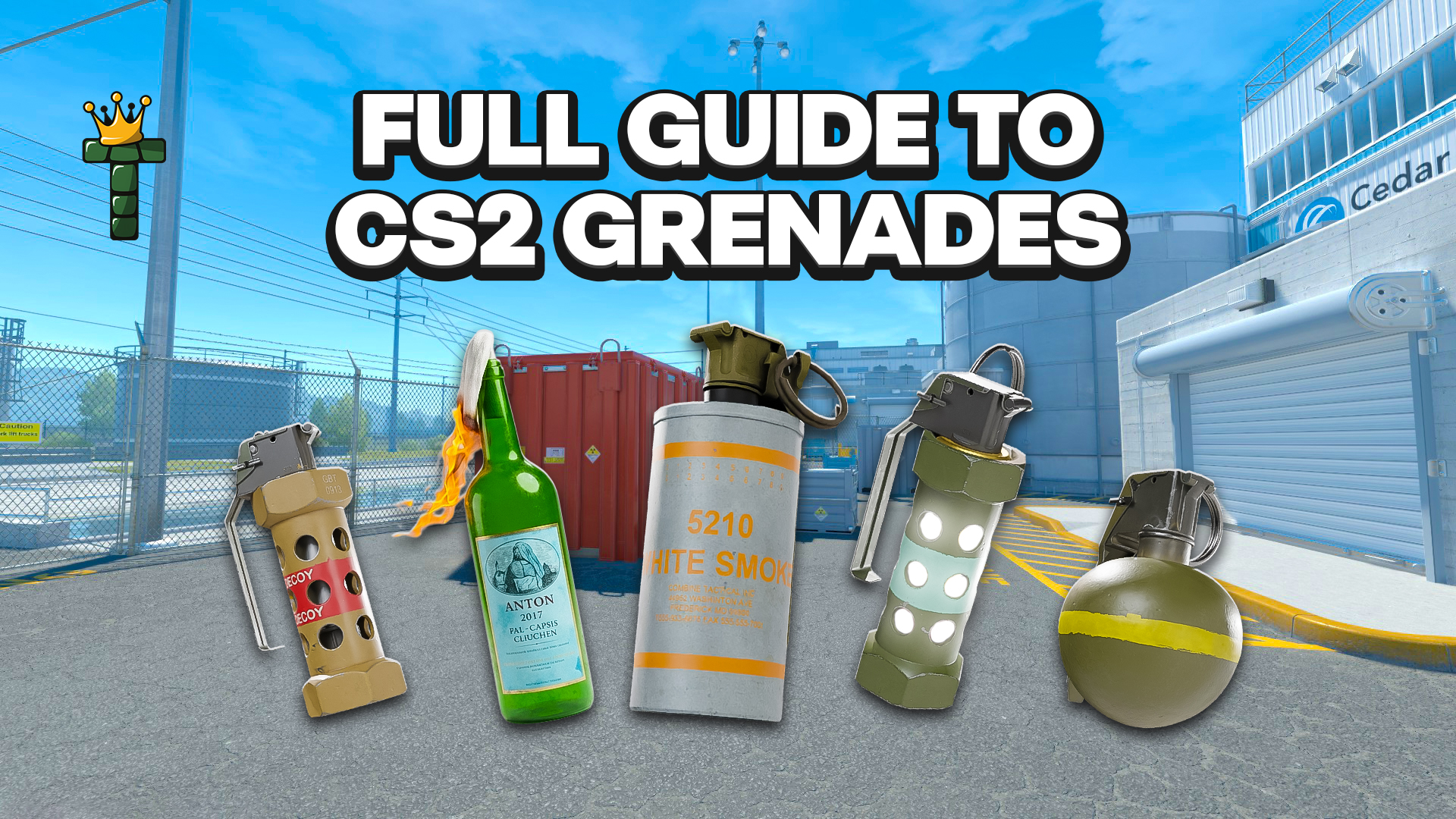
At lower ranks, most players treat grenades as an afterthought, something to buy with leftover cash. Higher-ranked players plan their buy around them. Every player can carry up to four grenades across three slots: one smoke, two flashbangs, and one item from the shared "explosive" slot, which holds a molotov or incendiary, an HE grenade, or a decoy. Because the HE and the decoy compete for that fourth slot, you can't carry both in the same round. Once you know when and how to use each one, you're worth a lot more to your team.
CS2 also changed how grenades behave compared to CS:GO. Smokes interact with the environment differently, and an HE grenade or the bomb's own detonation can briefly clear a smoke, which gives you a window to peek or spot enemies. Even veteran CS:GO players need to relearn some of the basics because of this.
The five grenade types
Smoke grenade, $300
Most players consider the smoke the most important grenade in competitive CS2. It costs $300, and you can only carry one. After it lands, it takes about two seconds to fully deploy into a thick screen that blocks vision for roughly 18 seconds and hides players inside it from the radar for most of that time. On offense, smokes cut off CT rotations, hide bomb plants, and let you cross open parts of the map that would otherwise get you killed. On defense, they block entry points and split up pushes.
To get real value from smokes, you need precise lineups. A smoke that lands two feet to the left of where you meant it to can leave a gap that gets you killed, so learn the exact throw position, crosshair placement, and throw style for each lineup you use.
CS2 also added a new smoke mechanic. Throw an HE grenade into a deployed smoke and the blast clears part of it for roughly two seconds. The HE's blast radius is smaller than the smoke, so it won't clear the whole cloud, but anyone hiding inside will be exposed for a moment.
Flashbang, $200
Flashbangs explode in a blinding white light and a loud ring that leaves affected players unable to see or hear properly for a short time. They cost $200, and they're the only grenade you can carry two of.
Flashes take a lot of practice. A bad one blinds your own teammates and does nothing to the enemy. A good pop flash, one that detonates right as it enters the enemy's view so they have almost no time to turn away, is one of the strongest tools in the game.
A few flash throws worth learning:
- Overhead throw: lob the flashbang over a wall or corner so it detonates on the other side.
- Pop flash: throw it at an angle so it curves around a corner and explodes almost immediately.
- Bounce flash: bounce it off a wall or ceiling before it detonates, which makes it very hard to anticipate.
Call out every flash before you throw it so your teammates can look away. A flash from one player while another pushes is one of the most effective plays in the game.
Molotov / incendiary grenade, $400 / $500
These two grenades work the same way, but each belongs to one side. Terrorists buy the Molotov ($400) and Counter-Terrorists buy the Incendiary Grenade ($500). Both create a patch of fire that burns for just over seven seconds. The damage ramps up the longer someone stands in it, from roughly 1 point per tick at first to as much as 40 damage per second by the end. Armor doesn't reduce it, and fire from several grenades stacks.
Common uses:
- On defense, deny a bomb plant or slow a rush through a choke point.
- On offense, flush enemies out of common holding spots.
- After the plant, keep the enemy off the bomb. Fire is one of the best tools for this.
A smoke grenade that lands directly in an active molotov or incendiary puts it out immediately. It has to land inside the fire's radius, since a smoke that lands nearby does nothing. Plan for this, especially at higher ranks, where opponents will smoke through your fire without hesitating.
HE grenade, $300
The High Explosive grenade damages everyone in a radius when it detonates. An unarmored player can take up to 98 damage from a direct hit at close range, while an armored player takes closer to half that. Damage drops off quickly with distance.
HE grenades work best on enemies whose position you already know, since they force them into the next gunfight with less health. You can also throw one into a smoke to clear it briefly, damage anyone inside, and throw them off.
Decoy grenade, $50
The decoy is the cheapest grenade at $50. It plays the sound of your primary weapon firing and shows a false position on the enemy minimap. Most players write it off, and they're missing something. Professional teams have used decoys to fake several players on one side of the map while the real push happens elsewhere. Former Astralis player Bubzkji built a reputation around this kind of creative decoy use.
Buy one when you have money left over and nothing better to spend it on. It costs almost nothing and can sometimes pull an enemy rotation away from your real push. Remember that it takes the same slot as your HE, molotov, or incendiary, so buying one means giving up the others.
Throwing techniques you need to know
The jump throw
Some lineups need a jump throw to get the right arc and distance. Valve's August 2024 update banned the classic jump-throw binds that combine the jump and the release into one keypress on official servers. You'll have to practice the manual version, jumping and then releasing the grenade right at the peak of the jump, until it's consistent.
Underhand throws
Right-click throws the grenade with a short underhand toss. It's useful for placing grenades close to you, like rolling a molotov into a nearby corner or dropping a flash just around an adjacent wall. A lot of players forget this throw exists.
Bounce throws
Bouncing a grenade off a wall or ceiling lets you reach angles a direct throw can't. This works especially well with flashbangs, because the unexpected angle and the extra travel time make them much harder to react to.
Movement while throwing
How you're moving when you release the grenade changes its trajectory. Running adds momentum and sends it further, walking is a reliable middle ground for mid-range throws, and standing still is the most consistent option for precise lineups. That's why you'll often need to stop completely before you throw.
How to practice grenades effectively
You learn grenades by practicing them on their own. CS2's built-in practice mode is a good place to start: go to Play > Practice, enable Grenade Camera, Infinite Ammo, and Infinite Warmup in the menu on the left, then load the map you want.
For full control, paste this into your developer console:
sv_cheats 1; bot_kick; mp_limitteams 0; mp_autoteambalance 0; mp_maxmoney 60000; mp_startmoney 60000; mp_buytime 9999; mp_buy_anywhere 1; mp_freezetime 0; mp_roundtime 60; sv_grenade_trajectory_prac_pipreview true; mp_roundtime_defuse 60; mp_respawn_on_death_ct 1; mp_respawn_on_death_t 1; sv_infinite_ammo 1; sv_showimpacts 1; sv_showimpacts_time 10; ammo_grenade_limit_total 5; mp_warmup_end; mp_restartgame 1
This lets you buy every grenade for free, throw as many as you want, and see impact markers after each throw. Type noclip in the console to fly around the map and follow your grenades from above, which is the easiest way to see exactly where a smoke or molotov lands.
Turn on CS2's grenade line-up reticle too. Once you pull the pin, it shows an extended crosshair with a ruler along it, which makes precise throws much easier to line up than the old CS:GO crosshair tricks.
Grenades in a team context
Good individual grenades only get you so far. Utility does the most damage when your team coordinates it.
Before an execute onto a bomb site, agree on which angles to smoke and who throws each one. If two players smoke the same angle, one of those smokes is wasted. Short, clear calls like "I've got CT, you take jungle" keep the execute clean.
Call your flashes before you throw them. Saying "flash out" gives your teammates a split second to look away.
Listen for enemy grenades as well. Smokes usually mean a planned execute, flashes mean a push is coming, and molotovs mean they know where you are. Recognizing the sound gives your team time to react before the grenade even lands.
Watching pro matches just to study their utility is one of the fastest ways to understand CS2 better. You'll notice they don't throw grenades randomly: each one is timed to fit the team's plan.
Common mistakes to avoid
The most common way players waste utility is eyeballing smoke lineups in live matches instead of learning the exact throw in practice mode first.
Self-flashing is another common and expensive mistake. If your flashbang hits a doorframe and bounces back, you've handed the enemy a free kill. Practice your angles until you know where every flash goes.
Don't buy grenades on eco rounds unless your team has agreed on a specific plan for them. Saving the money for the next round is almost always worth more.
Don't hoard them either. A molotov still in your inventory when the round ends is $400 wasted, and players at every rank die with unthrown grenades. Use your utility to create chances, even if the throw isn't perfect.
A player who's good with utility can make up for a lot of missing aim, and a team that executes with coordinated smokes, flashes, and molotovs can beat players who are individually better but play without a plan. Start with one map. Learn the five smokes that matter most, then the main flashes, then the molotov spots pros use every game, and build from there.